
Mail-order aligner kits promise a straighter smile without ever sitting in a dental chair. It is an appealing pitch, and for a narrow set of cases the underlying technology is sound. The question worth asking is not whether clear aligners work. They do. The question is who is planning the movement, who is watching it happen, and what occurs when something does not go as expected.
What Are At-Home Aligners?
At-home aligners are clear plastic trays ordered directly from a company rather than prescribed through an in-person orthodontic exam. You take your own impressions from a mailed kit or visit a scanning location once, a treatment plan is generated remotely, and a full series of trays arrives at your door. Progress is typically tracked through photos you upload yourself.
The trays themselves are made of similar thermoplastic material to any other aligner system. What differs is everything around them. There are no diagnostic X-rays, no periodic in-person checks, and usually no single named doctor examining your teeth before treatment begins or while it is underway.
That gap matters more than most people expect, because moving teeth is a medical procedure. Roots travel through bone. Gum tissue and the bone supporting each tooth have to keep up with the movement. Whether that goes well depends less on the plastic and more on the diagnosis behind it.
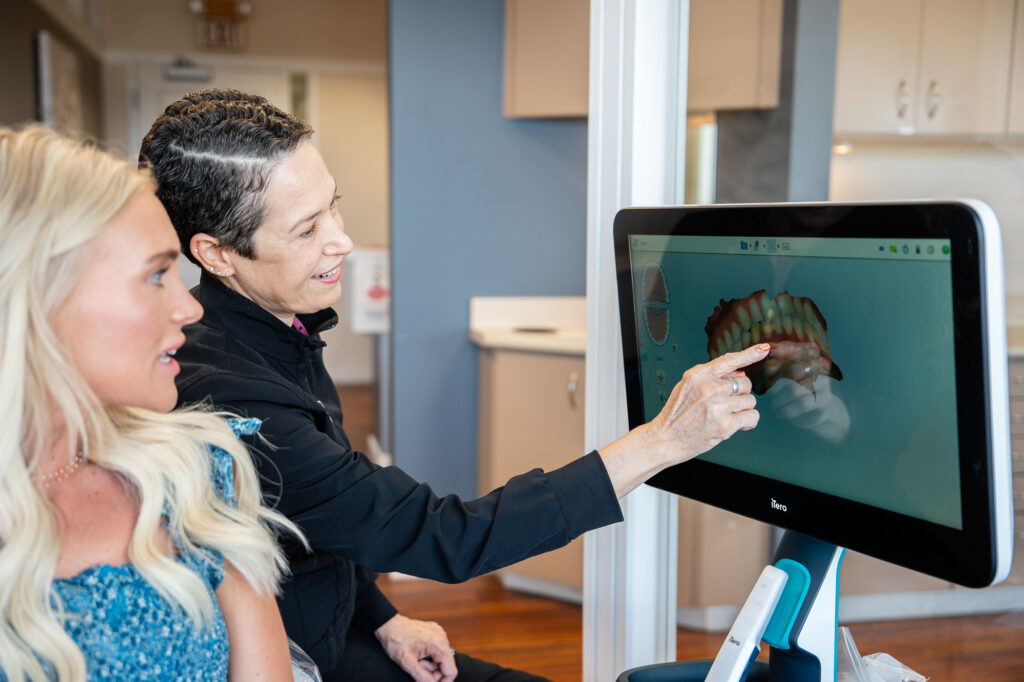
What an Orthodontist Adds to Clear Aligner Treatment
An orthodontist adds diagnosis, treatment planning, and mid-course correction. Records including digital X-rays and digital scans reveal root position, bone levels, and jaw relationships that photographs cannot show. In-person visits catch problems while they are still small, and treatment gets adjusted when teeth do not track the way the plan predicted.
Here is what happens before a single tray goes in at our practice.
- Full diagnostic records. Digital X-rays, digital photos, and digital scans instead of goopy impressions.
- Health screening first. Active gum disease, untreated decay, and root resorption all need attention before teeth are moved.
- A real treatment plan. Where each tooth needs to end up, in what sequence, and whether aligners are the right tool for your bite at all.
- Auxiliary planning. Attachments, elastics, and bite ramps get built into the plan from the start rather than bolted on later.
- Progress checks. Teeth that stop tracking their trays get caught early, when a small correction still fixes it.
Both Dr. Paul Bonham and Dr. Aurelia Bonham are board-certified orthodontists and Diplomates of the American Board of Orthodontics, and every case at both offices is planned personally by one of them.
At-Home Aligners vs. Orthodontist-Supervised Invisalign
The table below sets the two approaches side by side on the things that actually change outcomes.
| Factor | At-Home Aligner Kits | Invisalign With an Orthodontist |
|---|---|---|
| Initial exam | Self-taken impressions or a single scan visit | In-person exam with digital X-rays and scans |
| Who plans the case | Remote review, often without a named doctor you meet | Your treating orthodontist, personally |
| X-rays taken | Typically none | Standard part of records |
| Attachments and elastics | Generally unavailable | Used whenever the case calls for them |
| Bite correction | Alignment focused; bite changes limited | Alignment and bite treated together |
| Monitoring | Photos you upload | In-person checks with hands-on adjustment |
| If something goes wrong | Customer support, remote | An appointment with the doctor who planned your case |
| Case complexity handled | Mild crowding and spacing | Mild through complex, including many bite problems |
The most consequential row is the second-to-last one. Orthodontic treatment rarely fails dramatically. It drifts. A tooth stops seating fully in its tray, the next tray fits a little worse, and by tray twelve the series no longer matches the teeth. Caught at a routine check, that is a scan and a revised plan. Caught eight months later through uploaded photos, it is a much longer conversation.
There is also a business reality patients have run into. At-home aligner companies have shut down abruptly, leaving people partway through a tray series with no provider, no records, and no clear path forward. An orthodontic practice rooted in its community does not disappear between tray changes.
When Are At-Home Aligners a Reasonable Choice?
At-home aligners are most reasonable for very mild crowding or spacing in the front teeth, in a patient with a healthy bite, healthy gums, no missing or restored teeth in the movement path, and no history of orthodontic treatment. That is a real category of case. It is also a much smaller category than the marketing suggests.
Being honest about that cuts both ways. Some people genuinely have a simple front-tooth alignment issue and nothing else going on. Others assume they do, because the front teeth are what they see in the mirror, while the bite problem driving the crowding sits out of view.
Situations where remote aligners are a poor fit:
- Any bite problem, including an overbite, open bite, or crossbite
- Significant crowding requiring space creation
- Rotated teeth that need controlled, precise guidance
- Missing teeth, implants, bridges, or crowns in the treatment area
- Active gum disease or untreated decay
- Previous orthodontic treatment that has relapsed
- Growing children and most teens, where jaw development is part of the picture
The American Association of Orthodontists has raised concerns about direct-to-consumer orthodontics for exactly these reasons, particularly the absence of X-rays and in-person supervision.
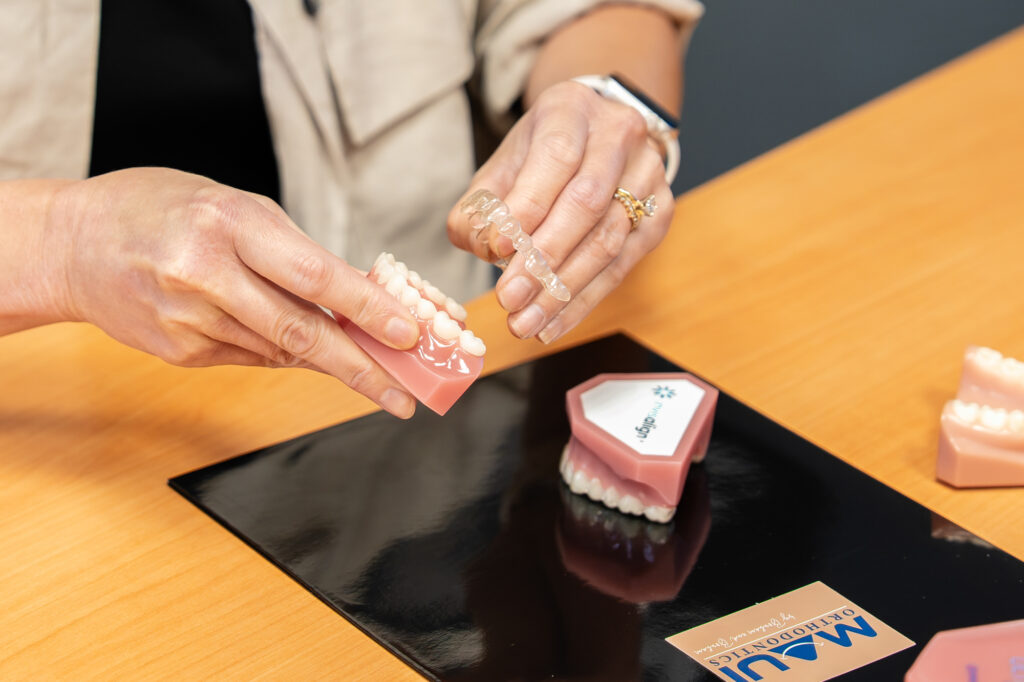
How We Handle Clear Aligner Treatment on Maui
Treatment starts with records and a conversation, not a tray series. At our office in Kahului and Upcountry in Pukalani, Dr. Paul and Dr. Aurelia review your digital scans and X-rays together before recommending anything.
Sometimes the answer is Invisalign clear aligners. Sometimes it is fixed braces, because the case involves movements that a removable tray struggles to deliver. Occasionally it is neither yet, because gum health or a growth-related issue needs to lead. You will hear which one it is and why.
Living on Maui adds one practical consideration worth naming. Getting a problem sorted out means seeing someone here, on island, rather than mailing trays back to the mainland and waiting. Two offices and local records make that straightforward.
Aligner treatment also depends heavily on you. Trays need roughly 20 to 22 hours of daily wear to move teeth on schedule, and the length of treatment tracks closely with how consistently they are worn. That is true regardless of who makes them.
You can look through real patient results from both offices, or book a free consultation and find out what your specific bite actually needs. There is no obligation and no sales pitch attached to finding out.
Frequently Asked Questions About At-Home Aligners
Are at-home aligners the same as Invisalign?
No. Invisalign is prescribed and managed by a licensed dentist or orthodontist who examines you in person, takes diagnostic records, and adjusts treatment as it progresses. At-home aligner companies generate a plan remotely, usually without X-rays, and monitor progress through photos you submit. The trays may look similar. The clinical oversight behind them is not comparable.
Can at-home aligners damage your teeth?
They can, in the wrong case. Moving teeth without first checking bone levels and root position risks root resorption, gum recession, and loosening of teeth already weakened by periodontal disease. Moving front teeth without addressing an underlying bite problem can also create new issues. This is why an exam and X-rays come before treatment rather than after.
Can I switch to Invisalign if my at-home aligner treatment stalls?
Usually yes. We start over with a full set of records to see where your teeth actually are now versus where the original plan expected them to be. From there, Dr. Paul or Dr. Aurelia builds a new plan. Bring whatever documentation you have from the previous treatment, since it helps to know what was attempted.
Do at-home aligners use attachments?
Generally not. Attachments are small tooth-colored shapes bonded to the teeth that give the aligner something to grip, which is how rotations and certain root movements get accomplished. Bonding and removing them requires an in-person visit, so remote systems typically go without. That limits which movements are achievable.
Is Invisalign worth seeing an orthodontist for if my case is simple?
The exam is worth it either way, because a case that looks simple in the mirror is not always simple on an X-ray. If your case really is straightforward, an orthodontist will tell you that and treatment will be short. If it is not, you will find out before you start rather than partway through a tray series.
How do I know whether my bite is part of the problem?
Most people cannot tell on their own, which is the honest answer. Bite relationships involve how the upper and lower teeth meet in three dimensions, and the parts that matter most are usually the back teeth. A brief exam settles it quickly.